
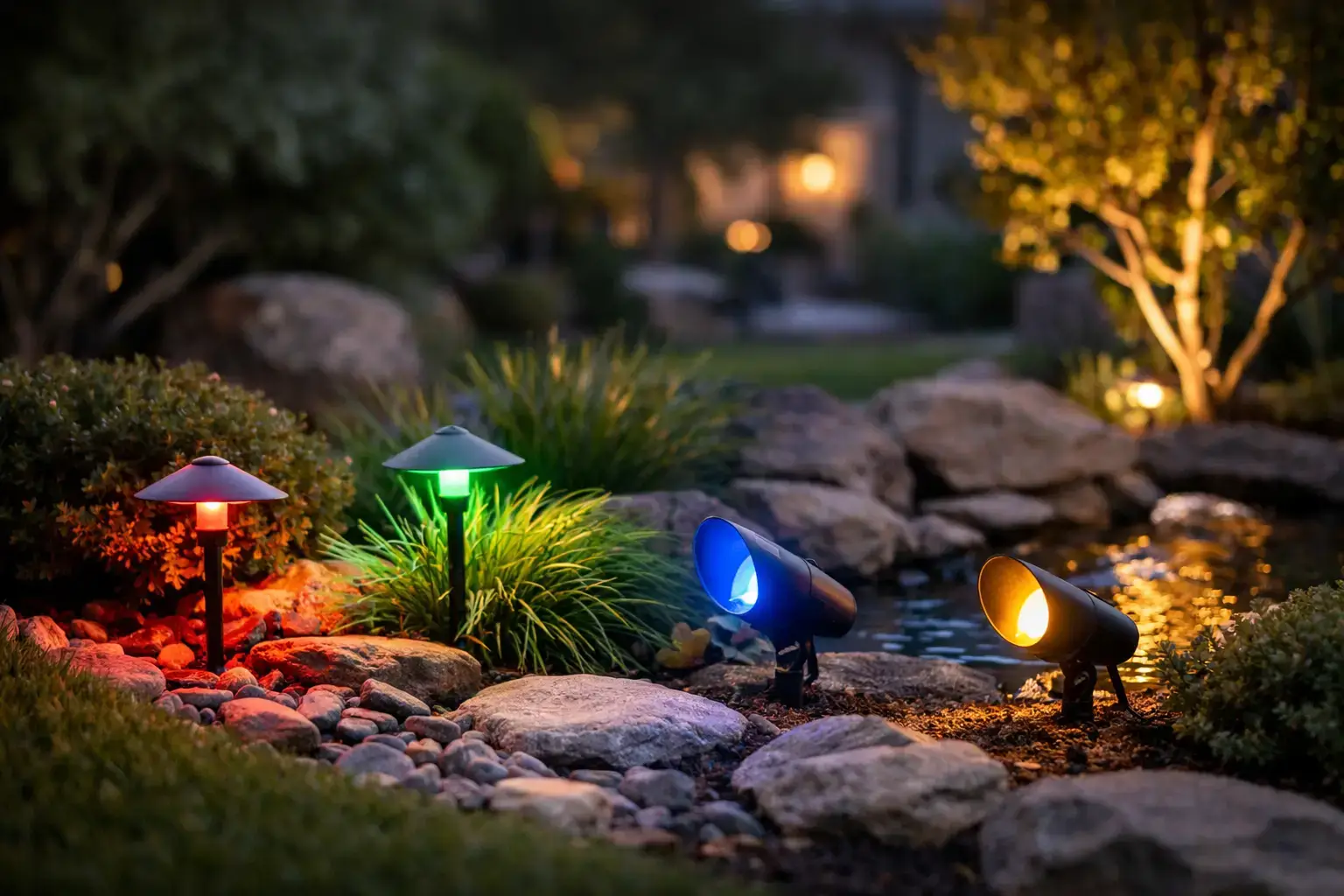
Your landscape lights already know how to make a house look polished after sunset. The missing piece is personality. Colored landscape light covers let you turn those existing white LED uplights into a bold red, cool blue, festive green, or custom color moment without changing a bulb, rewiring a fixture, or buying a new lighting system.
That matters when the calendar changes, when the big game is on, when guests are coming over, or when your property simply deserves more than the same white wash every night. A few well-placed color accents can make stone columns feel dramatic, make palms and ornamental trees pop, and give a front entry a reason to be noticed.
Permanent landscape lighting is a smart investment. It improves curb appeal, highlights architecture, and helps define paths and planting beds after dark. But traditional white LED bulbs are not built for every occasion. Swapping bulbs can be frustrating, and colored bulbs may not match your fixture, produce the effect you expected, or be worth storing for the other eleven months of the year.
Colored covers offer a simpler route. Instead of treating color as a separate lighting project, you add it to the fixtures you already use. The result is a quick visual change that preserves your existing setup.
For homeowners, that means seasonal decorating without another ladder, another box of specialty bulbs, or an electrician appointment. For HOAs, property managers, and businesses, it means a coordinated exterior look that can be updated for holidays, community events, school spirit, grand openings, or awareness campaigns without replacing an entire lighting plan.
A landscape light cover fits over a compatible uplight or bullet-light fixture and places a colored lens in front of the existing white light source. The white LED remains the engine. The cover changes the color of the output.
That distinction is worth understanding. You are not replacing the fixture or asking a colored bulb to do a job it was not designed for. You are using a purpose-built accessory to alter the appearance of light at the fixture level.
The best covers are designed for the outdoor environment, not improvised from plastic film or temporary craft materials. Outdoor fixtures create heat, face weather, and need to keep looking good from one occasion to the next. A cover should be heat-resistant, made to stretch securely over the fixture, and built around a real colored lens rather than a flimsy workaround.
Outdoor Light SOC was created for that exact job: a patented, one-piece reusable cover with an integrated polycarbonate colored lens. Its material is rated for heat up to 480°F and includes a UV-absorbing additive to help reduce fading. That makes the SOC a practical color upgrade for compatible LED landscape uplighting and bullet fixtures, not a one-night decoration.
Color is most effective when it has a job to do. A red cover can warm up a brick facade for Valentine’s Day or a holiday display. Green can bring extra depth to hedges and trees during the winter season. Blue can create a crisp, calm look around a pool enclosure, entry feature, or commercial sign.
The goal is rarely to color every fixture. In fact, selective color usually looks more intentional. Keep some white lighting where you need clarity and use colored uplights as accents. Let a pair of red lights frame a doorway. Use blue on two palms while white lights retain the shape of the house. Create a repeating pattern along a clubhouse, monument sign, or retail entry.
For larger properties, color can also make a familiar space feel newly cared for. A neighborhood entrance dressed in seasonal colors signals attention to detail. A restaurant patio with a subtle color change can set the tone for an event night. A business can use a recognizable color palette without installing bulky floodlights that overpower the property.
The first question is fit. Landscape fixtures vary in diameter, shape, and heat output, so a cover should be used only on compatible LED uplights or bullet lights. Measure the exterior of the fixture you plan to cover and review the product sizing guidance before ordering. A snug, secure fit helps the cover stay in place and creates a cleaner finished appearance.
Next, consider where the fixture is aimed. Uplights aimed at broad walls, large trunks, or dense foliage usually show color differently than lights aimed at narrow architectural details. Dark materials absorb more light. Light stone, stucco, and smooth tree bark tend to reveal color more visibly. The brighter the original white fixture, the more vivid the resulting colored effect may appear.
Color selection also depends on the mood you want. Red, green, orange, and purple lean festive and expressive. Blue can read cool and modern. Yellow can feel warm and welcoming. If you are buying for multiple seasons, an assorted set gives you more creative freedom than committing every fixture to one color.
Before you install covers across the whole property, test one fixture after dark. Look at the beam on the actual surface, then adjust the fixture angle if needed. A small repositioning can make the color appear richer, tighter, or more dramatic.
The appeal of colored landscape lighting should not come with a complicated installation process. If changing the color requires taking apart fixtures, replacing electrical components, or managing a tangle of temporary cords, the idea becomes less fun fast.
A stretchable cover changes that. With the fixture cool and switched off, place the cover over a compatible fixture according to the product directions. No tools, wiring changes, or bulb replacement should be necessary. Once installed, turn the light back on and enjoy the transformation.
That simplicity is especially useful for property managers and landscape professionals who need a repeatable solution across multiple fixtures. Instead of stocking various colored bulbs and tracking which lamp fits which fixture, they can use reusable covers to make timely changes while preserving the lighting system already in place.
There is still a common-sense trade-off: colored light is decorative, not a substitute for safety lighting. Keep pathways, steps, address numbers, and areas that need clear visibility properly illuminated. Use color to elevate the scene, while white light continues doing the practical work where it counts.
A strong color display has a focal point. Start at the entry, a specimen tree, a sign, or a central architectural feature. Then repeat the color once or twice elsewhere to make the property feel connected.
Avoid placing every color in every location. Red, green, blue, purple, and yellow can be a celebration, but all at once may compete with the architecture. For most homes, two colors are plenty. For commercial properties and larger holiday displays, a planned palette of three colors can work beautifully when each color has its own zone.
Timing matters, too. Put covers on before an event or holiday rush, then remove, store, and reuse them when the season changes. That is the advantage of a reusable retrofit: your lighting can keep up with your life without becoming permanent clutter.
Your exterior does not have to wait for a major renovation to feel fresh. Start with one feature worth showing off, choose a color that fits the moment, and let your existing landscape lights do something unexpected tonight.
Error: No feed with the ID 3 found.
Please go to the Instagram Feed settings page to create a feed.